V2X: Testing communication between vehicles and their environment for safer
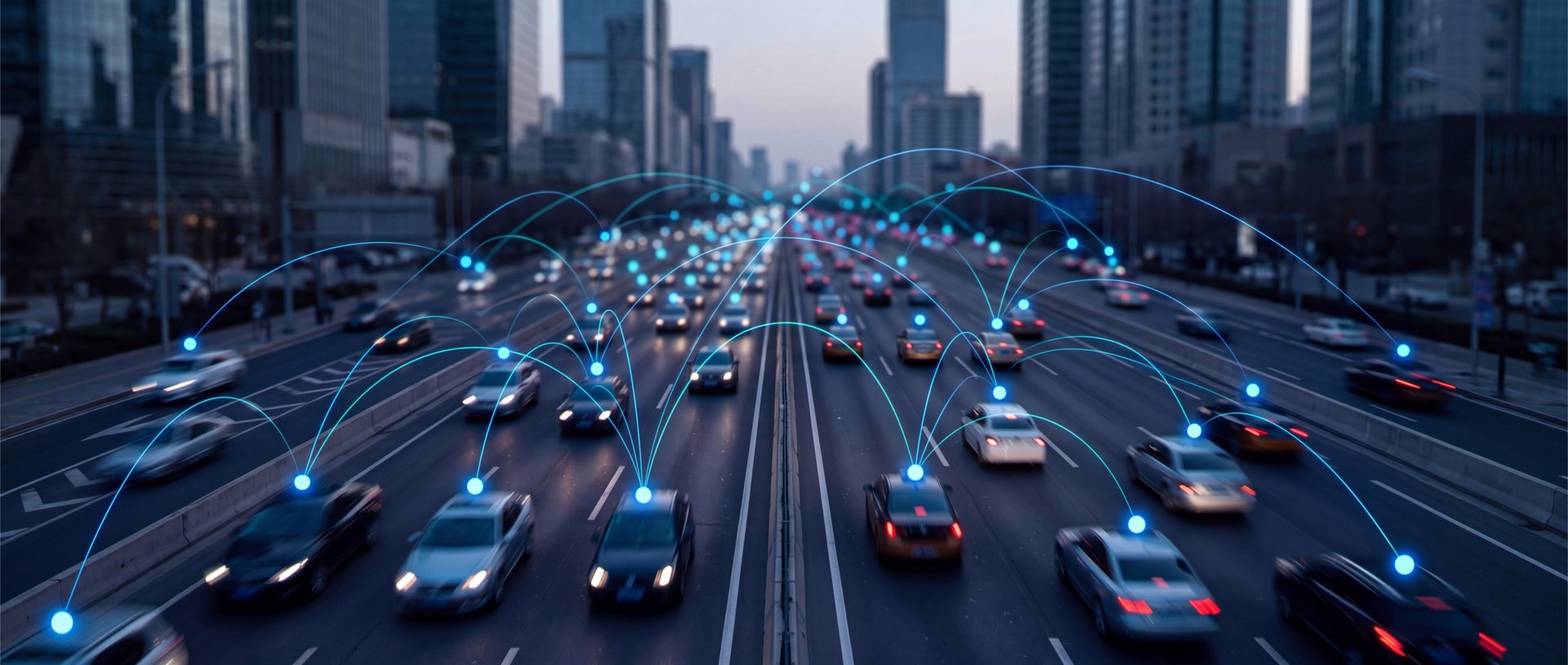
Connectivity is gradually transforming the automotive sector. Beyond onboard systems and advanced driver-assistance systems (ADAS), vehicles can now communicate with their environment through V2X (Vehicle-to-Everything) technologies.
Connectivity is gradually transforming the automotive sector. Beyond onboard systems and advanced driver-assistance systems (ADAS), vehicles can now communicate with their environment through V2X (Vehicle-to-Everything) technologies. The goal is to share real-time information between vehicles, road infrastructure, and other road users or mobility stakeholders, in order to improve the safety and efficiency of travel.
V2X encompasses several types of communication, depending on the entities being connected:
V2V (Vehicle-to-Vehicle): communication between vehicles to share information regarding their position, speed, or any detected hazards.
V2I (Vehicle-to-Infrastructure): communication between a vehicle and road infrastructure, such as traffic lights or connected signaling equipment.
The ambition is to supplement a vehicle’s own perception capabilities—such as cameras and radar—with information from external sources. This means the vehicle is no longer solely dependent on what its own sensors can directly detect.
Safety and traffic flow: two key expected benefits
One of the primary advantages of V2X is accident prevention, particularly in situations where visibility is limited.
Consider two vehicles arriving simultaneously at an intersection where the approach paths prevent the drivers from seeing one another. Without external information, the drivers might fail to anticipate the risk of a collision. With V2X, the vehicles can exchange information about their presence and trajectory. The onboard system can then alert the driver—or even help trigger a safety response, provided the vehicle is equipped with the appropriate functions.
V2X can also help improve traffic flow. A connected vehicle can communicate with a traffic light to receive information about its current state or the time remaining before it changes color.
These technologies are also of interest for priority vehicles. Buses, ambulances, or police vehicles equipped with compatible systems could transmit a request for priority to connected infrastructure.
Testing V2X: verifying communication reliability
Testing may focus on areas such as communication between devices, the consistency of the information exchanged, the management of driving scenarios, and the robustness of the system under degraded operating conditions.
These tests share similarities with those conducted for Advanced Driver Assistance Systems (ADAS). In both cases, an onboard system is subjected to representative scenarios to verify its response and evaluate its ability to function in accordance with defined requirements. The key difference lies in the role of data exchange between multiple devices—and, depending on the scenario, with external infrastructure.
Given the safety implications, these tests are carried out on private tracks and within controlled environments, rather than on public roads. This allows for the replication of specific situations, precise control over test conditions, and the verification of system behavior without exposing other road users to risk.
UTAC’s expertise in support of connected mobility
As a key player in the testing and evaluation of automotive technologies, UTAC supports the development of V2X systems through testing conducted on private tracks. The objective is to verify that connected equipment operates in accordance with defined scenarios and requirements, and that data exchanges between the various systems are correctly established.